
5 min read • July 16, 2026
When drivers have a problem, it doesn't happen in the office, but outside, at the vehicle, at the station, in the middle of everyday life. In exactly that moment, your customer service shapes how your customers perceive you. Providers who offer fast, competent support are valued by their customers. That's why the question keeps coming up: can we outsource customer service, or should we handle it ourselves? MOQO brings together what providers and drivers both need: transparency and closeness. What's happening right now? When do I get involved? Where can I step in, and how? This article shows how the MOQO Support Engine delivers exactly that transparency and control.
Education
Many car sharing providers want to handle customer service for their drivers themselves — for understandable reasons: service quality, brand identity, and direct driver relationships are all at stake.
But how can that work around the clock, without unsustainable financial and staffing effort?
The MOQO Support Engine takes these concerns seriously. It resolves around 90% of all first-level requests automatically — 24/7, in all languages, with no waiting time — while giving providers targeted control where it truly matters: feeding in their own knowledge, measuring service quality, and making critical decisions themselves.
Running a sharing service means having good reasons not to simply hand off driver support.
Ensuring service quality
How requests are handled determines whether drivers get their problem solved. Poor support directly impacts satisfaction and user retention.
Maintaining direct driver relationships
Many providers know their users personally or have built trust over years. They don't want that replaced by an anonymous support function.
Protecting brand identity
How you communicate is part of the brand experience. Tone, language, response time — none of this is irrelevant.
Bringing in internal knowledge
The specifics of your vehicles, local regulations, specific fare structures — that knowledge sits with the provider, not with an external service provider.
Retaining decision responsibility
In critical cases like refunds, complaints, or unusual behavior, the decision should rest with the provider.
These are legitimate expectations. They reflect a sense of responsibility toward your own service and the people who use it.
At the same time, practice shows: anyone who wants to handle every support case manually runs into limits fast — and risks the very things they set out to protect.
As request volume grows, waiting times rise. Anyone who needs help at night or on the weekend won't get it. Knowledge that lives with one or two people disappears the moment they're unavailable. Service quality fluctuates, and that leaves a mark: in how the service is rated, in whether people recommend it, and ultimately in the provider's reputation.
Manual support processes simply don't scale. At some point, the volume is too high to give every case the timely personal attention it deserves.
How effective complaint management affects customer retention →

The MOQO Support Engine is designed to give providers manual control where it matters, while taking over the part that can be safely automated.
Around 90% of all requests fall into the second category: questions about bookings, invoices, and vehicle access. For these, chat and phone are available 24 hours a day, 7 days a week — in all languages, with no waiting time.
Both chat and hotline already know the driver's name, their account status, and the context of their request at first contact. That means every response is specific to that person and that situation, not a generic, one-size-fits-all answer.
Why we rebuilt our B2C chatbot →
Escalation only happens when it's truly necessary, and according to clear rules:
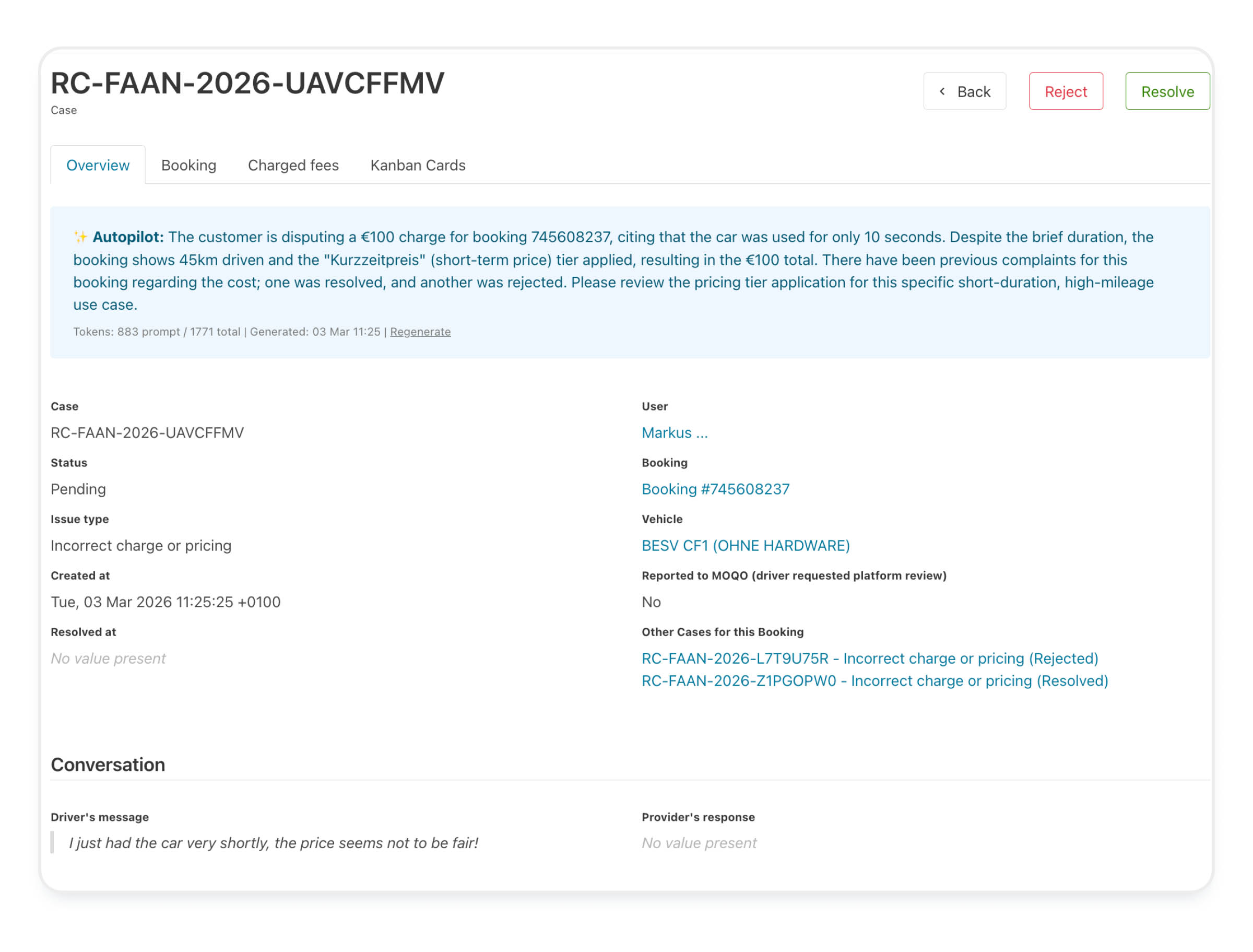
The MOQO Support Engine gives providers concrete tools to steer service quality, bring in their own knowledge, and, when it matters, make decisions and get in direct contact with their drivers.
Support FAQs
Every provider defines the information and answers the first-level support works with. Provider-specific knowledge is structured, permanently available, and no longer dependent on who happens to be reachable.
Resolution Center
Escalated requests and reports land in the Resolution Center in a structured way. There, providers make decisions on matters like refunds, complaints, or suspected fraud. Regular use of the Resolution Center also reveals patterns — for example, when problems with a specific vehicle pile up, or a fare repeatedly causes confusion. That allows providers to step in and address recurring issues early.
The Resolution Center: handling complaints in car sharing systematically →
Metrics and ratings
Drivers rate their support experience. These ratings are visible in the Provider Portal. Anyone who sees a negative rating can respond directly, before the next driver runs into the same problem.
The MOQO support team
Cases the first-level support can't resolve go to the MOQO team and are handled there. The team knows the platform and the typical request patterns, and can resolve more complex cases directly. If a situation carries risk or a decision should rest with the provider, they proactively reach out.

The MOQO Support Engine gives providers both: 24/7 support that helps drivers without waiting time, and consistent control, through their own guidelines or direct decisions as needed, so you stay in direct contact with your drivers when it counts.
It addresses provider concerns head-on:
Learn more about the Customer Support Engine on the MOQO platform →