6 min read • July 6, 2026
Companies that handle complaints and disputes in the shared mobility sector in a structured manner retain drivers who might otherwise have left without a formal process in place. The MOQO Resolution Center provides sharing service providers with a workflow that allows decisions to be made quickly while remaining transparent.
Product
Shared mobility providers receive complaints from drivers every day: disputed charges, missing refunds, and disputed damage claims. Many providers handle these cases reactively and without a standardized process. The result is inconsistency that is poorly documented and difficult to analyze. The MOQO Resolution Center creates a structured workflow: All information relevant to the decision is displayed in a single view, allowing decisions to be made in seconds and documented later. This article explains why a structured complaint process — especially for growing providers — goes far beyond the individual ticket.
A reserved vehicle could not be unlocked. A charge does not match the reserved rental period. A claim of damage is being disputed. Situations like these are part of everyday life for shared mobility providers, and the key question is not whether complaints arise, but what happens afterward.
Many providers don’t have a structured response to this. Complaints end up in an email inbox or a ticket system and are handled by different employees. The decision depends on who happens to be available at the time, how the case is phrased, and how objective the other party has remained.
The result is inconsistency, and that is more costly than it seems, because once the fleet reaches a certain size, it becomes a structural problem.
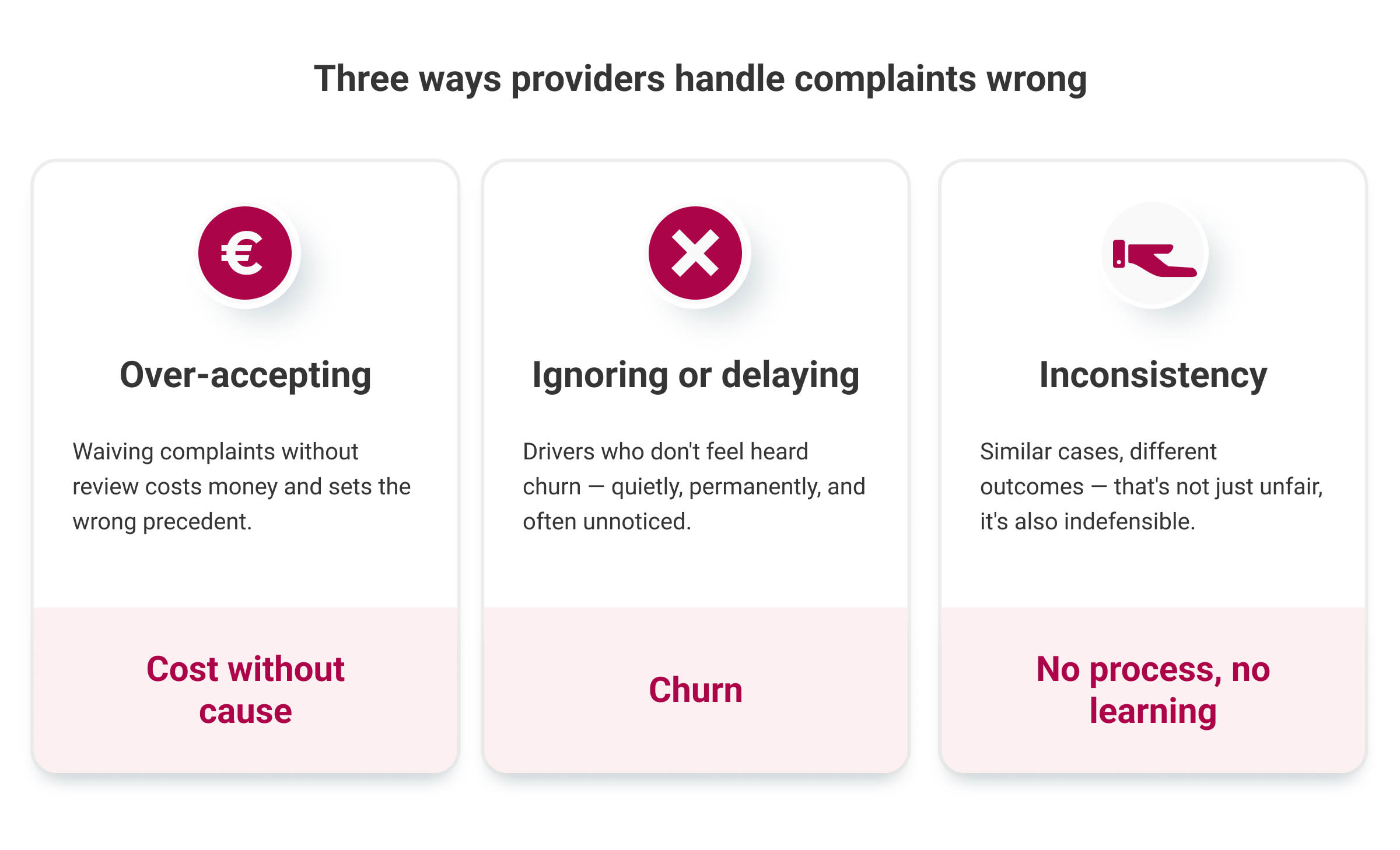
Most providers handle complaints in one of three ways, and all three come at a cost.
Accepting claims too often may prevent short-term conflicts, but showing goodwill without verifying the facts is not a process. As a provider, you end up bearing costs that you did not incur and set a precedent: whoever is loudest gets their way.
Ignoring or delaying complaints protects the budget, but only in the short term. Drivers whose complaints go unaddressed are more likely to leave than those whose complaints were resolved quickly and clearly.
Inconsistency is the most underestimated problem. When similar cases are decided differently, it is not only unfair but also indefensible. This can be particularly relevant in disputes over damages.
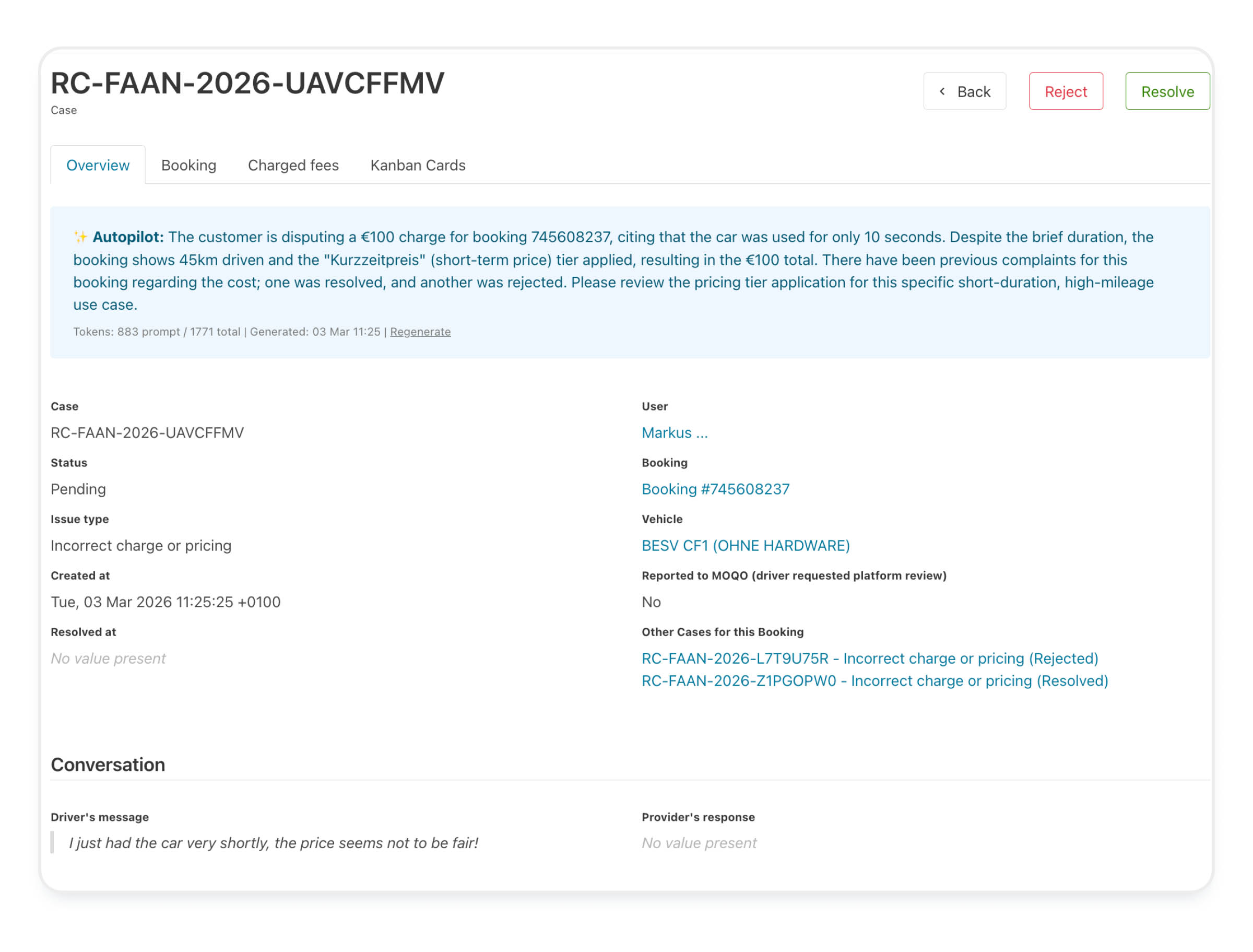
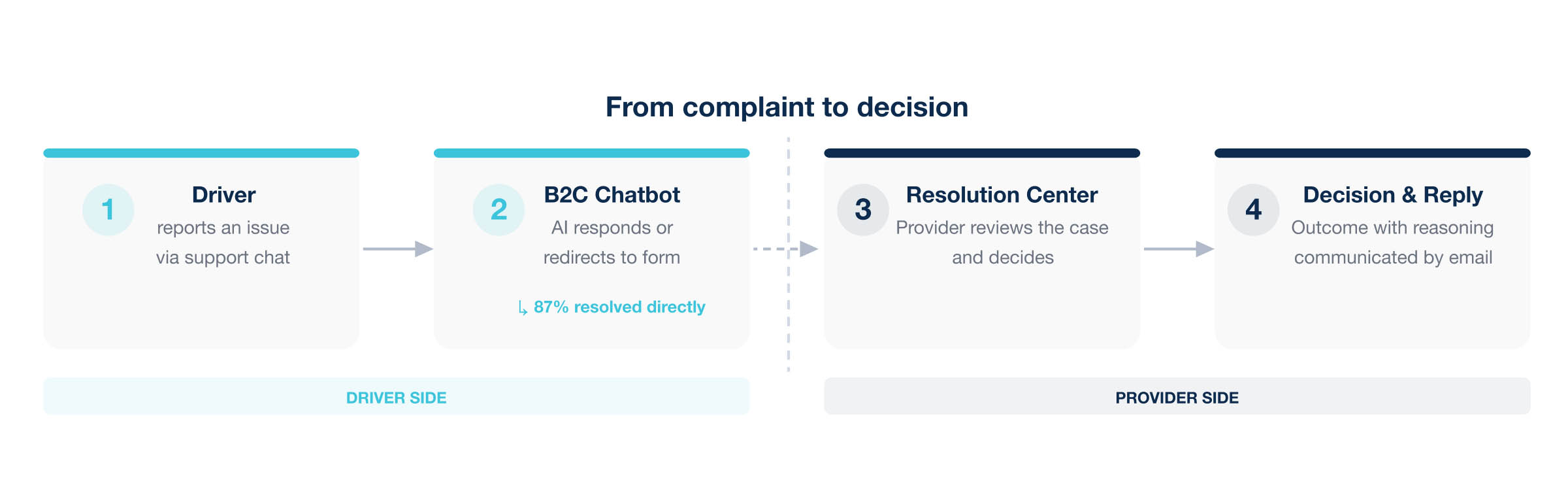
Through the Resolution Center, sharing providers can manage cases on the MOQO platform in one central location. Drivers access the form via the support chat, fill it out, and use it to submit their case directly to the provider. The form provides a clear structure for the case from the very beginning, as it guides users step by step through the relevant information.
This allows providers to see at a glance everything they need to make an informed decision:
The decision-making process is intentionally kept simple: accept or reject, with a written explanation in each case. Drivers then receive the decision via email, and the case is closed. If additional information is needed, providers can request it directly from the drivers.
This way, decisions can not only be made quickly, but they are also documented and can be traced if necessary.
The initial contact is not made via the form, but through Fin, the AI-based B2C support chatbot. Fin handles the vast majority of driver inquiries directly, since standard questions do not require a case to be opened. If an issue cannot be resolved automatically, Fin directs drivers to the form.
This has a practical implication for service providers: The initial contact via chat addresses the customer's emotions, so that in the Resolution Center, you only need to review the case objectively.
About the upgrade to an AI-based B2C chatbot →
Drivers who file a complaint wonder: Is there a process in place? Will my case actually be reviewed? A system that responds quickly, communicates clearly, and provides a well-reasoned decision conveys professionalism, even if the decision is a rejection.
Research on customer retention shows that complaints that are resolved quickly and transparently can strengthen customer loyalty. According to some studies, 95% of these customers make repeat purchases, compared to less than 40% of those who had a problem but never reported it.
After all, seeing how a provider handles a problem tells you more about that provider than seeing one where everything runs smoothly. The Resolution Center gives providers the tools they need to ensure that this moment isn't left to chance.
How effective complaint management and user retention are linked →
For providers with larger fleets or multiple customer service employees, consistency is not a matter of quality, but an operational necessity.
When multiple people handle complaints without having the same level of information and without a standardized format for decisions, the result is not a learning curve but a series of case-by-case decisions. These are difficult to defend and even harder to evaluate.
The Resolution Center does not enforce this structure, but enable it: Every case follows the same structure, every decision is documented, and post-closure feedback is visible. The integrated metrics show case volume, resolution times, and satisfaction rates for the current and the previous month. For many providers, this is the first time that complaint management is visible as aggregated data, rather than just as closed tickets.

Complaints in car or bike sharing services do not become less frequent as the fleet grows. They become more numerous, more varied, and harder to handle if there is no structured process in place.
The MOQO Resolution Center serves as the link between a well-functioning B2C support system and a robust decision-making structure on the provider side. It is not an interface for individual tickets, but rather the foundation that ensures complaint handling for shared mobility providers is consistent, traceable, and measurable.