
4 min read • October 12, 2026
To enable drivers to refuel or charge a car sharing vehicle, operators need a reliable payment solution at gas stations or charging stations. For a long time, there were essentially two ways to do this: prepayment followed by reimbursement, or a fuel card stored in the vehicle. Now, a third option has emerged that challenges both approaches: digital refueling directly through the app. Here’s an overview of all three models and their respective pros and cons for car sharing operations.
Education
Today, car sharing operators have three options for organizing fueling and charging for their fleet: prepayment by users, physical fuel or charging cards in the vehicle, or digital fueling via an app. Prepayment is still common, particularly in traditional car rental, where drivers often cover fuel costs themselves; however, in carsharing, it results in a high manual reimbursement burden and discourages users from booking vehicles with low fuel levels. Fuel cards solve this problem but come with their own challenges: card logistics, PIN management, wear and tear, and a certain risk of misuse. Digital refueling - which MOQO has been offering to all car sharing partners since August 2026 through the full integration of ryd - replaces the physical card with app-based, location- and user-specific authorization, thereby providing greater control with less operational effort. Which option is best depends on the operator’s business model, fleet size, and level of digitalization.
This approach is still most common in the traditional car rental business: Traditional car rental companies often follow a “full-to-full” policy, under which fuel costs are not included in the rental price, and drivers are responsible for refueling and paying for it themselves. In car sharing, however, where the price per kilometer typically already includes fuel costs, the same principle leads to significant inefficiencies.
Without a card in the vehicle, there’s really only one option: users pay for fuel out of their own pocket and then submit the receipt to the operator. For drivers, this means paying upfront and waiting for reimbursement - an inconvenience that reduces their willingness to book a vehicle with a low fuel level in the first place or to refuel while driving.
On the operator’s side, the effort involved in verifying and reimbursing expenses grows in proportion to the size of the fleet: every invoice must be individually verified, assigned, and reimbursed. For a scaling car sharing operation, this model is hardly sustainable in the long run.

The fuel or charging card stored in the vehicle has become the standard solution in carsharing over the years. Operators select a card issuer whose network covers their own service area and register the card via the vehicle’s telematics module. Payments are then processed directly through the operator, who receives monthly consolidated invoices instead of numerous individual reimbursements.
The cost of this is operational overhead elsewhere: cards wear out due to heat and cold inside the vehicle, and RFID readers or card slots fail. When the fleet is replaced, cards must be reassigned, mailed, and exchanged - an effort that increases with the size of the fleet.
Since cards are not uniquely linked to a specific person, there is also a risk of misuse: lost cards, cards that have been passed on to others, or cards used in other people’s vehicles can only be detected after a delay.
With the integration of ryd, MOQO has been offering all sharing partners a third option since August 2026: Users can start the refueling or charging process directly in the MOQO app without needing a physical card in the vehicle.
The app displays nearby gas stations from the ryd network, which is currently available in ten European countries and includes approximately 15,000 gas stations and over one million charging points; in Germany, this includes the Aral and Esso networks, as well as numerous independent gas stations. Once at their vehicle, drivers select the appropriate pump in the app and activate it. Billing then takes place automatically in the background between ryd and the operator.
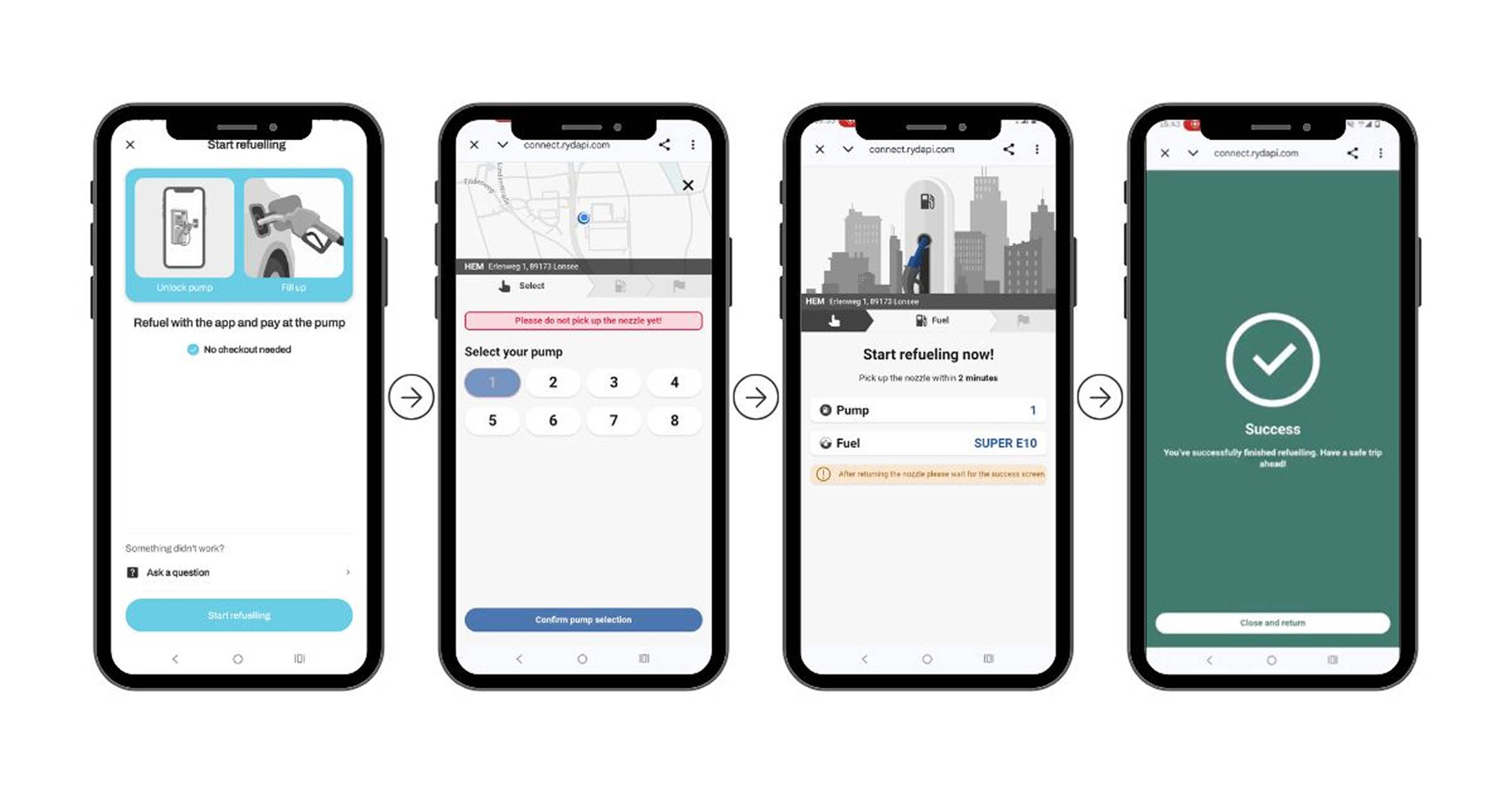
Authorization is handled via geofencing: the app and the vehicle’s location are cross-checked against the selected station; in addition, rules such as a maximum amount per refueling or minimum intervals between two bookings can be set. Global rate limits provide additional protection against misuse. Because each transaction is linked to the time, location, vehicle, and user, the risk of fraud is significantly lower than with a physical card.
For accounting purposes, the system automatically links each invoice to the corresponding booking, eliminating the need for manual reconciliation of fuel receipts. For operators, this also completely eliminates the need to mail cards, manage PINs, and exchange them when vehicles are added to or removed from the fleet. All fueling transactions can be viewed in real time on the MOQO portal as well as on the complementary ryd portal.
Anyone who wants to get a feel for the process in advance can also try it out for free as a private user via the ryd app, without any sharing involved. Experience has shown that this option significantly lowers the barrier to entry for drivers.


Prepayment may still work in traditional rental businesses, but it is hardly suitable for a growing car sharing operation, as it creates extra work for both sides and slows down usage. Fuel cards remain a solid, widely used solution, but they come with their own operational costs. Digital refueling via the app further reduces this effort and provides greater transparency and real-time control - a model that really shines for scaling fleets. Operators don’t have to force themselves to make a complete switch right away: Digital refueling can be activated on a per-vehicle basis and thus tested gradually alongside the existing fuel card.
Operators who have been working with well-established fuel card processes for some time might initially consider a switch unnecessary - after all, the existing solution seems to be working. However, the effort involved in card logistics, PIN management, and adding or removing vehicles from the fleet continues to grow with each additional vehicle group, whereas digital fueling does not require this additional effort to grow along with it. Fuel fraud and a poor user experience are other recurring issues with the existing solution. Since the transition can be tested on a vehicle-by-vehicle basis without disrupting ongoing operations, no one has to switch over completely right away: Those who start early with individual vehicles gain experience before the switch becomes necessary anyway as the fleet grows.