

5 min read • November 23, 2026
Example: Which vehicles have been idle over the past five days? Until now, answering this question required a CSV export, a spreadsheet, and twenty minutes, which is why it was often left undone in day-to-day operations. With the MOQO AI Assistant, providers can now ask their carsharing software questions in plain language and get the answer based on their own data.
Product
MOQO AI is an assistant within the MOQO Portal that answers questions about your company’s operational data: fleet status, bookings, revenue, claims, and payments. Questions are asked in plain language, and the answers are provided as text, tables, charts, or maps, along with direct links to the relevant portal view. MOQO AI only reads data and does not modify anything; access is limited to the user’s role and their own organization, and the data is hosted and processed within the EU. Beyond simply providing information, agents can generate comprehensive analyses such as utilization rates or revenue per vehicle and station.
In larger organizations, there’s a division of labor when it comes to operational issues: one person handles the question, while another sets up the analysis. In carsharing, day-to-day operations often look different. A company with one to three people in charge of the fleet has no one to whom this task can be delegated. Anyone who wants to know which vehicles are idle has to set up the export themselves, all while dealing with damage reports, trips to the stations, and customer inquiries.
In this way, relevant questions disappear from day-to-day operations without anyone consciously deciding to do so. It’s rarely the difficult questions that get left behind, but rather the moderately important ones: those whose answers would be useful but aren’t urgent enough to set aside twenty minutes for. Over the course of a year, these make up the majority of the questions a company might ask itself.
So the key factor lies less in the speed of the response than in who is actually able to access it. That is precisely what changes when there is no longer a spreadsheet standing between the question and the answer.
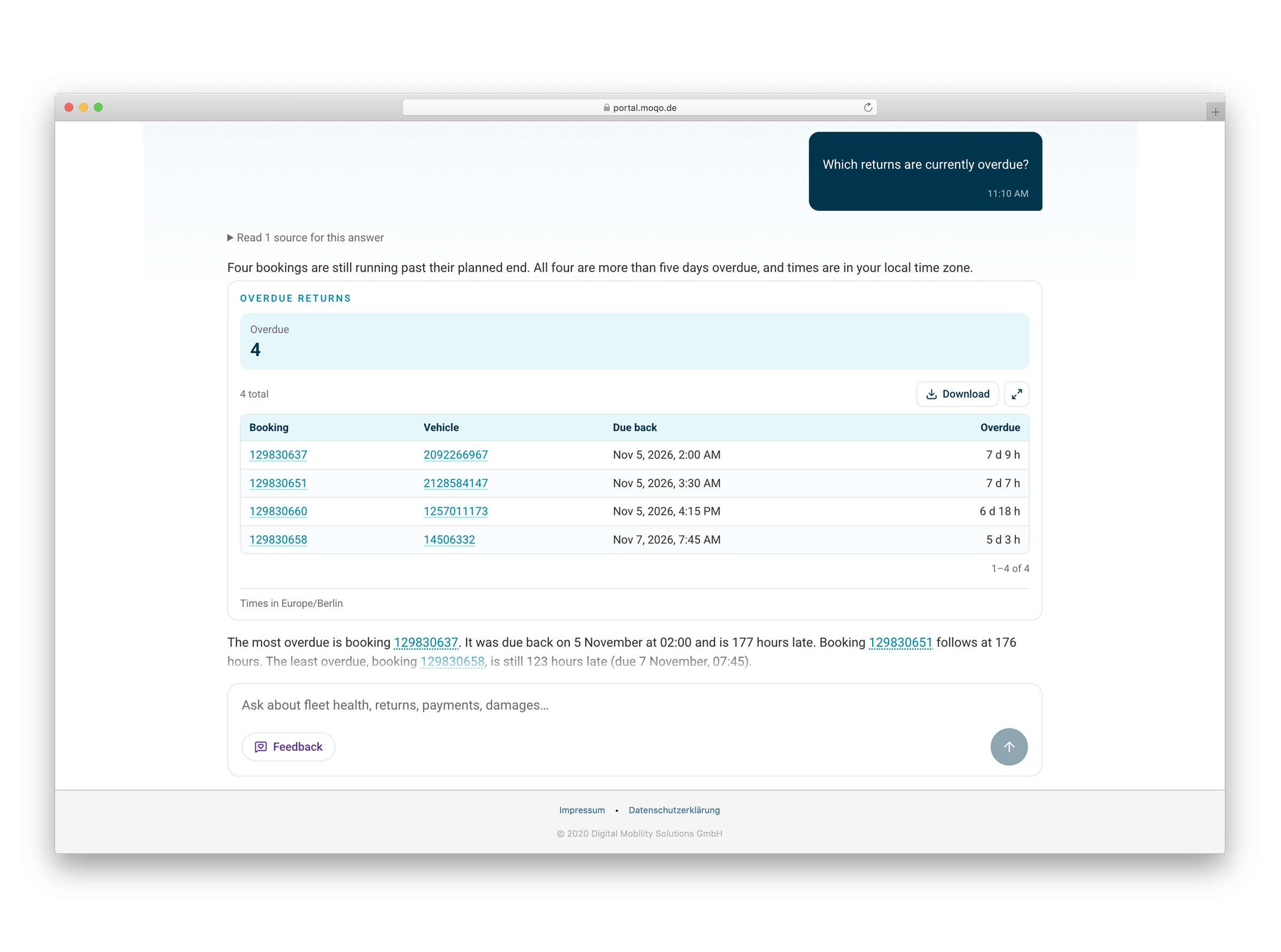
With the MOQO AI Assistant, you can now ask your question just as you would ask a colleague, and receive a concise answer with numbers or a list. When it helps clarify the issue, a table, chart, or map is included.
Each answer includes direct links to the exact portal view where you can continue your work. Follow-up questions work within the same workflow, so you can narrow down or expand on an analysis without having to start over.
Three of the most common questions providers ask on a daily basis:
What stands out here is the pattern: People almost always ask about what isn't going well right now. It is precisely these questions that end up costing the most in day-to-day business if they remain unanswered.
Let's take the first of these above questions. Until now, the process of finding the answer involved exporting vehicle and booking data, calculating daily differences based on timestamps in a spreadsheet, and manually filtering out active bookings. Multiple steps, multiple tools, and in the end, a list that has to be completely rebuilt the following week.
With MOQO AI, you simply ask a question and receive a list of the affected vehicles, along with their downtime, current location, and a link to each vehicle's individual page. From there, you can check the battery and cleaning status or reassign vehicles to stations with higher demand.
“That's what dashboards and exports are for,” is the obvious objection. However, both have a fixed format. A dashboard displays the metrics it was built for, while an export provides columns from which you build the analysis yourself.
MOQO AI, on the other hand, answers questions that span multiple data fields and that no one had anticipated. Service life combined with station location, bookings combined with payments: combinations that don’t appear on any single screen. You can download the results as a CSV file or copy them directly to Excel, Google Sheets, or Markdown if you want to continue working with them.

Data-driven analyses are particularly valuable when the results are used to identify specific actions. In the case of the example question, “Which vehicles have been idle over the past five days?” the answer should be followed by a follow-up question: How can the utilization of these idle vehicles be improved in the future?
For example, providers can reevaluate and, if necessary, restructure their vehicle allocation or plan additional marketing initiatives to attract new users. The MOQO AI Assistant can help with this as well; simply ask it specifically about potential factors affecting utilization and how to derive appropriate actions.
As a general rule: The assistant reads but does not write. It does not open doors, cancel bookings, issue credit memos, or modify fleet data. Access is strictly limited to the logged-in role and the user’s own organization: You cannot request information that you are not authorized to view in the portal. The data does not leave the EU; session storage is strictly limited and covered by the existing Data Processing Agreement (DPA).
User-related profile and behavioral data have been intentionally excluded in accordance with Article 22 of the GDPR and the AI Act. The responses come from a read replica in real time, so you are seeing the current status rather than last night’s data.

Alongside the assistant are the agents. While the assistant answers a question, an agent handles an entire task: It gathers the necessary data, performs calculations, presents an exportable result, and - where the process requires it and you grant permission - carries out related actions in the portal.
It all started with three agents for recurring analyses: utilization per vehicle, revenue per vehicle and station, and fuel consumption per vehicle and station. These are reports that used to require a great deal of manual work. Another agent already in operation is the Provider Board Agent, which analyzes, categorizes, and prioritizes tickets, moves them on the board, and closes cases. Next in line are agents designed to support providers and alleviate their workload when it comes to disputes and booking adjustments.

The difference the MOQO AI assistant makes is less a matter of speed than of approach. Operational questions are asked by the person who has them, without the need to export data and without having to silently weigh whether the effort is worth it.
The next step involves additional agents that take on complete tasks: structured workflows with human approval. Incidentally, analyzing the questions asked of the assistant also helps in deciding which agents are most important for providers: If you ask for an action that the MOQO AI cannot yet perform, you’ll be told exactly that - but by making this request, you’ll also influence what gets built next.
As a MOQO partner, you’ll find the AI assistant right in your MOQO portal, just click “Ask AI” there. For more information on features and activation, visit the Provider Academy.